
Introducing Jalayer (Jolly) Khalilzadeh
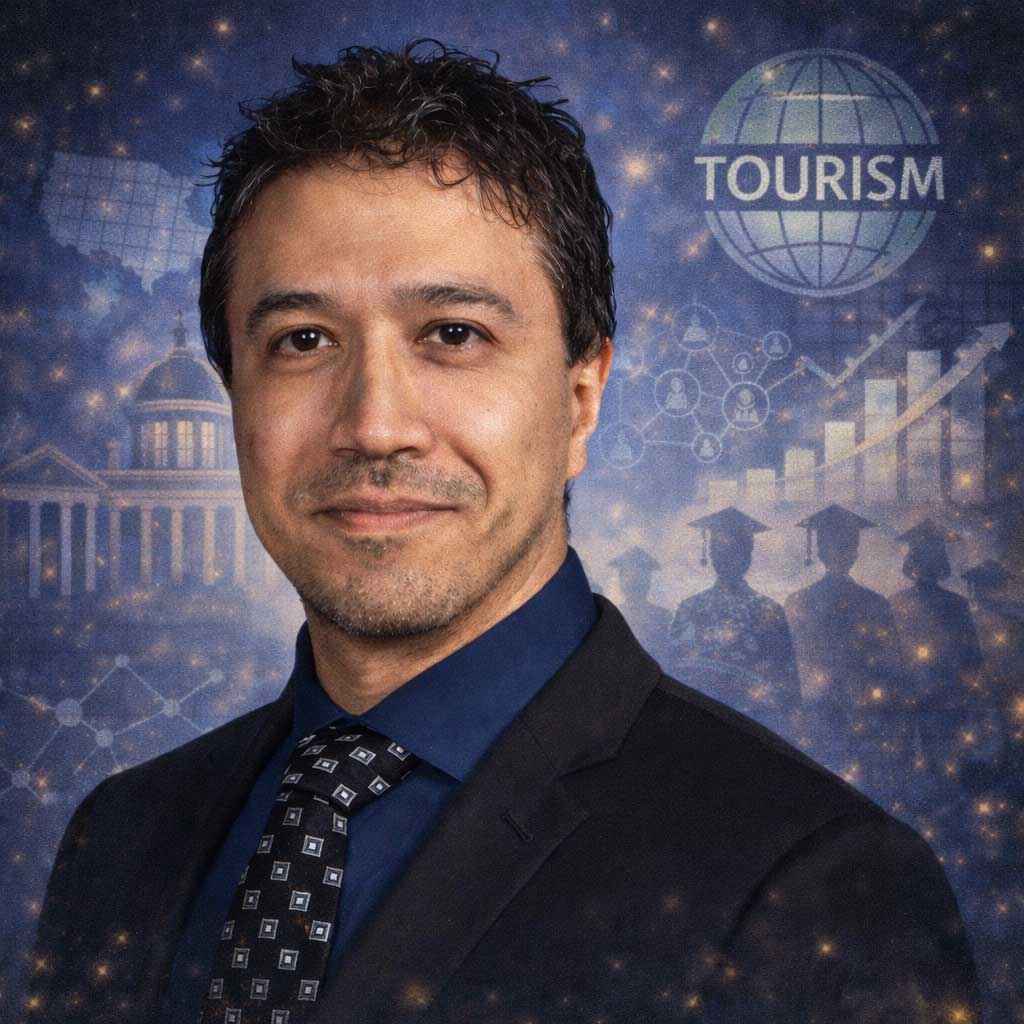
Meet Jalayer (Jolly) Khalilzadeh, Associate Professor at East Carolina University and a member of the SETTRA Board having served for one year. In his role, he leads the Graduate Certificate in Sustainable Tourism and drives a robust research agenda focused on network science, complex systems, and tourism analytics.
What is your current role with your organization?
I currently serve as an Associate Professor in the School of Hospitality Leadership at the College of Business, East Carolina University. In this role, I teach undergraduate and graduate courses, lead the Graduate Certificate in Sustainable Tourism, and contribute to curriculum development. I actively conduct research in network science, complex systems, and tourism/hospitality analytics, mentor students, and participate in departmental and college committees related to assessment, scholarship, and personnel. I also maintain a productive research agenda supported by external collaborations, grant activity, and ongoing scholarly publication.
Where It All Started
What initially drew you to the travel and tourism research field?
I entered the travel and tourism field because I was fascinated by how people move, interact, and experience the world through destinations. Early in my academic and professional journey, I worked across several areas of the industry—from lodging and restaurants to tour operations and destination management—which gave me a firsthand understanding of how complex, interconnected, and dynamic tourism systems really are. Those experiences sparked my curiosity about the deeper structures behind traveler behavior, destination performance, and the systems that shape hospitality and tourism.
Over time, this curiosity grew into a passion for understanding tourism not just as an industry, but as a complex adaptive system. That perspective eventually led me into research, where I found the tools—particularly network science and system science—that allowed me to study the patterns, relationships, and structures driving travel behavior and global tourism dynamics. That combination of real-world experience and analytical fascination is what initially drew me into tourism research and continues to motivate my work today.
Meaningful Work & Impact
Is there a specific research project are you most proud of and why? Can you share the real-world impact that work had?
One of the research projects I am most proud of is the development of the Octomodal Mental Imagery (OMI) Scale, which I published in Tourism Management Perspectives in 2023. This project stands out because it required several years of conceptual development, rigorous psychometric testing, and multidisciplinary thinking. I designed the scale to measure imagination and prospection in experiential consumption—two constructs that are fundamental to how people anticipate, visualize, and emotionally engage with destinations, products, and experiences.
What makes this project especially meaningful to me is its practical impact. The OMI Scale gives researchers, tourism organizations, and experience-driven companies a validated tool to understand how consumers imagine future travel experiences, how imagery influences decision-making, and how destinations can shape more compelling narratives. Since its publication, the scale has been used in studies examining destination branding, experiential marketing, and traveler decision processes—helping bridge psychological theory with actionable insights for tourism marketers and planners.
Beyond its academic value, the project has advanced a deeper understanding of how mental imagery drives destination choice and experience formation, offering real-world implications for improving marketing communications, enhancing visitor engagement, and designing more immersive tourism experiences. For me, this blend of conceptual rigor and applied relevance is what makes the OMI project one of the most meaningful contributions of my research career.
Board Perspective
What inspired you to get involved with the SETTRA board / What have you enjoyed most?
I became involved with the SETTRA board because I wanted to contribute more directly to strengthening the regional research community in travel and tourism. Throughout my career, I’ve valued organizations that bring scholars, practitioners, and industry leaders together, and SETTRA plays a unique role in elevating applied tourism research across the Southeast. When the opportunity arose to serve, it felt like a natural extension of my commitment to advancing evidence-based insights in our field.
What I’ve enjoyed most is the sense of collaboration and purpose that drives the board’s work. SETTRA provides a platform where research can translate into meaningful conversations with destinations, policymakers, and businesses. Being part of a group that is passionate about creating those connections – and about supporting emerging scholars and students – has been both energizing and rewarding. It has also allowed me to contribute my expertise in complex systems and tourism analytics to broader regional conversations, which I find personally fulfilling and professionally impactful.
Advice & Outlook
What advice would you give to emerging professionals interested in research or data in travel and tourism?
My biggest advice for emerging professionals is to stay curious and stay interdisciplinary. Tourism is not just an industry – it’s a living system influenced by psychology, economics, geography, culture, technology, and now more than ever, data science. The most impactful researchers and analysts are the ones who can bridge those worlds and see patterns others might miss.
I also encourage students to build a strong foundation in analytics, research methodology, and systems thinking. Whether you are working with big data, surveys, social media networks, or visitor flows, your ability to ask the right questions and design rigorous methods will set you apart. Don’t shy away from learning tools such as R, Python, GIS, or network analysis – they open doors to insights that traditional approaches may overlook.
Another important piece of advice is to lean into real-world experience. Work with destinations, tourism organizations, or research labs whenever possible. Those hands-on experiences will sharpen your understanding of how data is used in decision-making, what problems matter most to practitioners, and how your work can drive meaningful change.
Finally, stay patient and persistent. Research takes time, and meaningful insights often come from long-term exploration. If you stay curious, stay grounded in solid methods, and stay connected to industry needs, you’ll find that this field offers endless opportunities to contribute knowledge that truly matters.
Where do you see key opportunities for research in this field in the next few years?
In the coming years, I see some of the biggest opportunities in tourism research emerging at the intersection of data, systems thinking, and technological transformation.
First, there is tremendous potential in applying complex systems and network science to understand how destinations evolve, how travelers influence each other, and how global tourism systems respond to shocks. As travel patterns become more interconnected and dynamic, systems-based methods will be essential for forecasting, resilience planning, and destination management.
Second, advances in AI, machine learning, and real-time analytics will open new doors for studying visitor flows, sentiment, digital behavior, and experience design. These tools can help us better understand how people imagine, plan, and evaluate their travel experiences, and they can support smarter decision-making for destinations and tourism businesses.
Third, I see great opportunity in research focused on sustainability and resilience—not just as policy goals, but as measurable, data-driven processes. Climate change, resource constraints, and social disruptions demand new models for understanding how tourism systems adapt and where vulnerabilities exist.
Finally, the rise of digital discourse systems—from social media to online communities—creates rich opportunities to study how narratives, values, and collective perceptions shape travel motivation and destination image. This area aligns closely with my current work on discourse systems and tourism motivation.
Overall, the future of tourism research will favor approaches that blend advanced analytics, interdisciplinary theory, and real-world applicability, and I’m excited about how these directions can contribute to more resilient, informed, and sustainable tourism systems.
Fun & Personality
What’s one surprising fact about you?
One surprising fact about me is that before becoming a researcher and professor, I spent several years working in hands-on roles across the tourism and hospitality industry, including as a banquet manager for high-profile diplomatic events and even providing simultaneous interpretation for foreign diplomats (I can speak four languages). Those early experiences not only shaped my understanding of the industry but also continue to influence how I think about systems, interactions, and service today.
Outside of research and data, what’s your favorite way to recharge?
I enjoy hiking, cooking, watching soccer and tennis. I am a movie buff and enjoy watching all sort of movies and tv series.
What destination is currently at the top of your must-visit list?
Switzerland, Norway, Italy, Greece, and the U.S. national parks. I also love to go back to Scotland whenever I can.
Get In Touch



TTRA is a highly respected and established organization dedicated to advancing the standards of travel and tourism research and analysis. With its focus on excellence, professionalism, quality, and inclusivity, TTRA is the go-to source for professionals in the industry seeking to stay ahead in their field.